
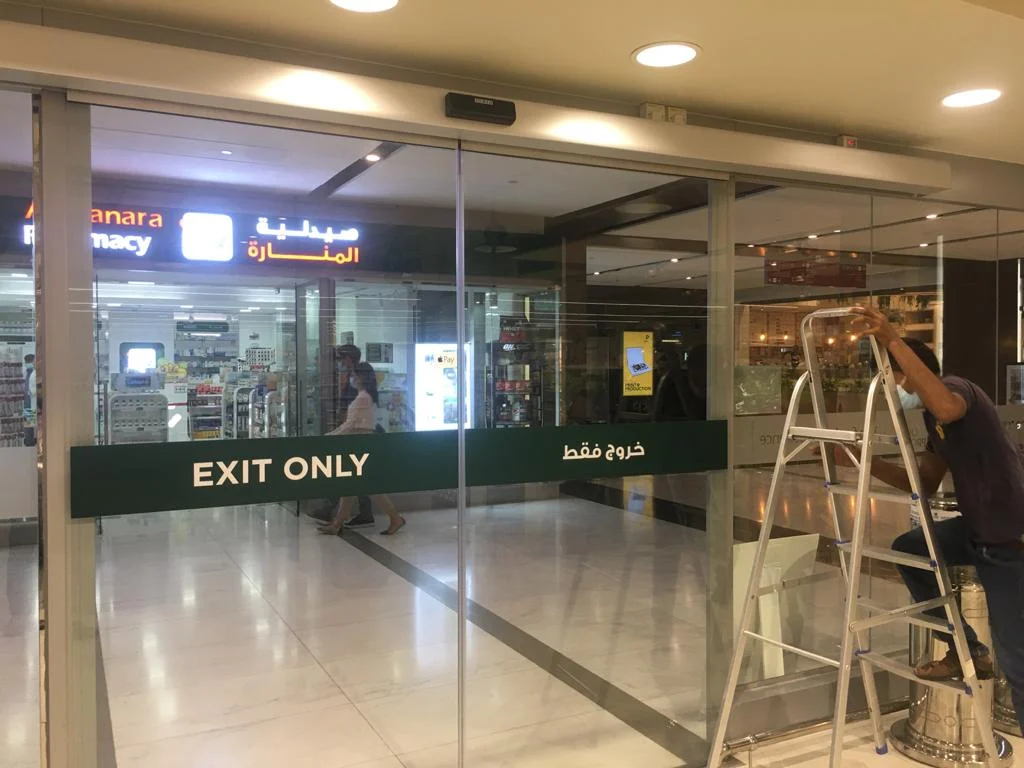
Most automatic door failures come down to a handful of causes: a dirty or misaligned sensor, debris in the floor guide, a worn belt or roller, a tripped power supply or the wrong programme setting. A few of these you can check safely yourself. Anything involving the operator, the glass or the wiring needs a technician.
Safe checks you can do first
- Power: is the door’s isolator or circuit breaker on? Has there been a power cut?
- Programme switch: check it hasn’t been left on locked, exit-only or manual mode.
- Sensors: gently wipe the sensor covers above and beside the door with a soft dry cloth. Dust and condensation are common culprits.
- Floor guide and threshold: clear sand, stones, coins or debris from the bottom guide.
- Obstructions: look for mats, signs, plants or displays near the door that a sensor could be detecting.
Don’t force the panels by hand, open the operator cover, or keep using a door that closes onto people. Switch it to manual or locked and call a technician.
Door won’t open
Usually a power, programme or sensor issue. If the motor hums but nothing moves, the belt may have slipped or snapped, or the panel may be jammed in the floor guide. If there is no sound at all, the control unit or power supply is the likely cause.
Door won’t close or keeps reopening
The presence sensor thinks someone is in the doorway. Check for a mat edge, a sign, a plant or a reflection in the sensor field, and clean the sensor. A misaligned or failing safety sensor will keep the door open too, and needs recalibrating or replacing.
Door opens by itself
The activation sensor is picking up movement it should ignore: people walking past rather than towards the door, traffic, rain, swaying signs or sunlight. A technician can reshape the detection field, reduce sensitivity or replace the sensor.
Door is slow, noisy or jerky
Worn carriage rollers, a slack or worn belt, dirt on the track or sand in the floor guide cause most of these problems. Grinding or squealing should be looked at quickly, because a worn roller can damage the track if it is left.
Door alignment problems
If panels rub the floor, leave uneven gaps, clash in the middle or catch the floor guide, the door is out of alignment. Common causes are worn rollers, loose carriage fixings, a damaged floor guide or a track that has shifted. Alignment matters for more than looks: a misaligned door can stop the safety sensors working correctly.
Manual sliding and folding doors
The same principles apply to manual aluminium sliding and folding doors: most sticking and stiffness comes from worn rollers, dirty tracks, loose hinges or doors that have dropped out of alignment. These are usually repairable without replacing the door.
Repair or replace?
If the problem is a sensor, motor, operator, belt, rollers, alignment or access control, a repair is usually possible. Replacement makes sense when the system is badly damaged, parts are no longer available, or the door no longer suits how the entrance is used.
What to tell the technician
- The door type (sliding, telescopic, swing, folding or pivot) and brand if you can see it, such as GEZE, Dorma or Kematic
- What the door is doing, and when: all the time, only in the morning, only when it rains
- Any error code shown on the programme switch
- A short video of the problem
Send these on WhatsApp and SmartFix can often tell you what to expect before the visit. Book through our automatic door repair service.
How often should automatic doors be serviced?
At least once a year, which is the minimum expected by EN 16005, and more often for busy commercial entrances. Regular servicing catches worn rollers, slack belts and drifting sensors before they stop the door.
About this guide
This guide was written by the SmartFix Doors and Windows team, who supply, install and service aluminium, glass and automatic door systems across Dubai from our workshop in Al Quoz. If you would like advice on a specific opening, book a site visit or message us on WhatsApp.
Frequently asked questions
Why is my automatic door not opening?
Check the power supply and programme switch first, then clean the sensors and clear the floor guide. If the motor hums but the door doesn’t move, the belt or a jammed panel is likely. If there is no sound at all, it is usually a power or control unit fault that needs a technician.
Why does my automatic door keep opening and closing?
The sensors are detecting something in or near the doorway, such as a mat, sign, plant, reflection or people walking past. Clean the sensors and remove obstructions. If it continues, the sensors need recalibrating or replacing by a technician.
Can I fix an automatic door myself?
You can safely check the power, programme switch, sensor covers and floor guide. Don’t open the operator cover, adjust the belt or force the panels: automatic doors are heavy and the mechanism is under tension. Anything beyond basic checks should be done by a trained technician.
How much does automatic door repair cost in Dubai?
It depends on the fault. Cleaning or adjusting a sensor costs far less than replacing a motor, control unit or belt. A technician needs to inspect the door to quote accurately, so send a video of the problem on WhatsApp first.
Does SmartFix repair automatic doors in Dubai?
Yes. SmartFix repairs and maintains automatic sliding, telescopic, swing, folding and pivot doors across Dubai, including GEZE, Dorma and Kematic systems, and repairs manual sliding and folding doors too.
Door Still Not Working? Send SmartFix the door type, brand and a short video on WhatsApp, and we will arrange a technician visit. Book a site visit or message us on WhatsApp.