
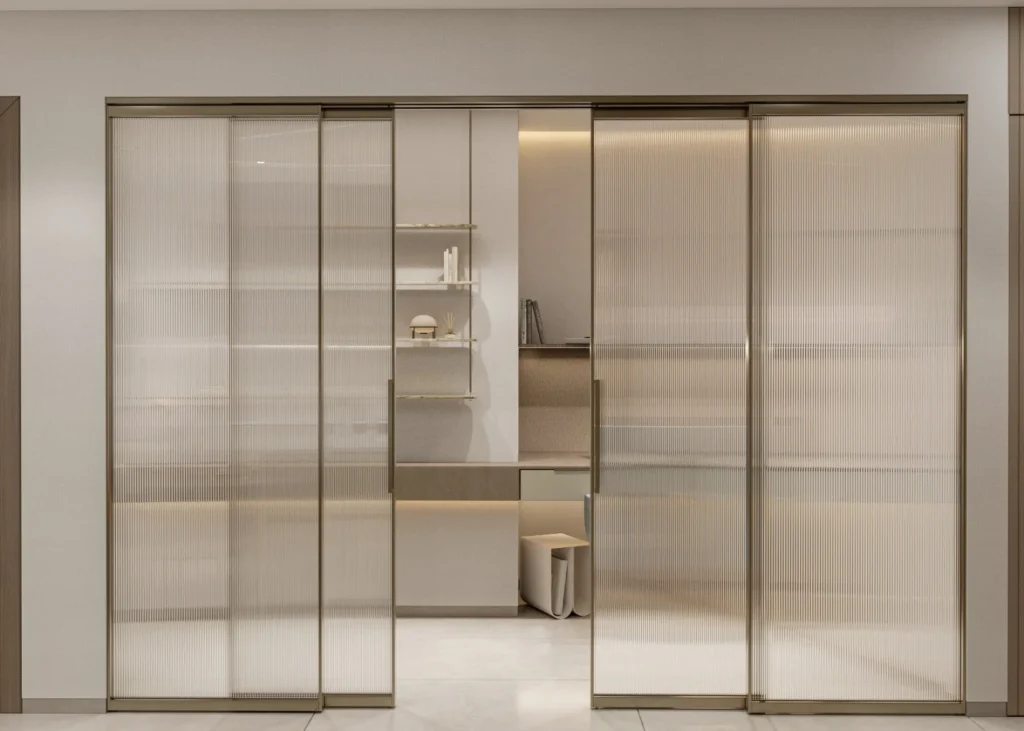
A telescopic door is a sliding door split into two or more panels that run on parallel tracks and move together, so they stack neatly behind one another when the door opens. You get a noticeably wider clear opening than a standard sliding door gives you in the same wall space.
How does a telescopic door work?
Each panel of a telescopic door runs on its own track, set slightly in front of or behind its neighbour. The panels are linked, by a belt and pulley system or a mechanical linkage, so that when the leading panel moves, the others follow at a proportional speed. When the door opens, every panel arrives at the stacking position at the same moment and sits behind the others. When it closes, they fan back out across the opening.
That is where the name comes from: the panels slide out and back like the sections of a telescope. You will also see the same product called a telescoping door or telescoping sliding door.
How much wider is the opening?
This is the main reason to choose a telescopic door. A standard automatic sliding door needs a fixed panel beside each moving panel for it to slide behind, so roughly half the structural width is taken up by parked glass. Splitting each moving leaf into two narrower panels means they stack into a smaller space.
As a rule of thumb, a telescopic door gives a clear walk-through opening of nearly 60% of the total structural width, compared with about 45% for a standard bi-parting sliding door (source: Stanley Access Technologies). On a 4-metre-wide entrance, that difference is roughly 60 cm of extra clear width, enough to change how easily a hospital bed, a luggage trolley or two people side by side can pass.
What types of telescopic door are there?
- Single-slide or bi-parting: single-slide doors stack to one side; bi-parting (centre-opening) doors stack to both sides for the widest openings.
- Two-panel, three-panel or more: more panels mean narrower stacking, but more tracks and moving parts. Industry systems range from two to five panels sliding in one direction, and up to eight in a bi-parting layout.
- Framed aluminium or frameless glass: aluminium frames suit heavier panels and thermal or security needs; frameless glass gives the cleanest look.
- Manual or automatic: manual telescopic doors are common in villas; motorised systems with sensors are standard for commercial entrances.
SmartFix supplies two-panel, three-panel and wider multi-panel telescopic doors, in aluminium-framed and frameless glass, manual and motorised. You can see the range on our telescopic doors Dubai page.
Telescopic door vs standard sliding door vs bi-fold
- Standard sliding door: simplest and least expensive, but parks the moving panel over an equally wide fixed panel, so you lose about half the opening.
- Telescopic door: the best choice when side space is limited but you still want a wide opening, especially for automatic commercial entrances.
- Bi-fold door: opens almost the full width, but panels fold out into the room or onto the terrace, which needs clear floor space and suits manual residential use better than busy entrances.
Where do telescopic doors make the most sense?
Telescopic doors earn their place wherever the opening needs to be wide but the wall beside it is short: hospital and clinic corridors where beds pass, hotel entrances with luggage traffic, shop fronts squeezed between columns, and lobbies with a narrow return wall. In villas, manual telescopic doors are popular for garden, pool and terrace openings where you want most of the wall to open without panels folding into the room.
Automatic telescopic doors: safety and maintenance
Automatic telescopic doors in Europe are designed and tested to EN 16005, the safety standard for power-operated pedestrian doors, and the same standard is widely used as a benchmark in the UAE. It covers safety sensors, opening forces and the risk of people being struck or trapped, and it expects powered doors to be maintained at least once a year.
Telescopic doors have more rollers and tracks than a standard slider, so they reward regular servicing. In Dubai, fine sand and dust are the usual enemy: debris in the floor guide makes panels drag and can throw the linkage out of sync. Ask for the bottom guide and tracks to be cleaned and checked at every service.
If an existing door is already sticking or running unevenly, our automatic door repair team can inspect it.
What affects the cost of a telescopic door?
Panel count, overall width and height, framed or frameless glass, glass specification, manual or automatic operation, the operator brand, sensors and access control, and the structure available above the opening all affect the price. SmartFix quotes after measuring the opening, because the clear width you need decides the panel layout.
About this guide
This guide was written by the SmartFix Doors and Windows team, who supply, install and service aluminium, glass and automatic door systems across Dubai from our workshop in Al Quoz. If you would like advice on a specific opening, book a site visit or message us on WhatsApp.
Frequently asked questions
Is a telescoping door the same as a telescopic door?
Yes. Telescoping door, telescoping sliding door and telescopic door all describe the same system: two or more linked sliding panels on parallel tracks that stack behind each other when open, giving a wider clear opening than a standard sliding door in the same wall space.
How many panels does a telescopic door have?
At least two per moving side. Common layouts are two-panel and three-panel single-slide doors, or four and six panels in a bi-parting, centre-opening arrangement. More panels give a wider opening for the same stacking space, but add tracks and moving parts to maintain.
Can an existing sliding door be converted to telescopic?
Sometimes, but it usually means replacing the track, header and panels rather than adapting the old ones, because each telescopic panel needs its own track and a linkage. SmartFix checks the opening and the structure above it before recommending a conversion or a new system.
Are telescopic doors manual or automatic?
Both. Manual telescopic doors are common in villas for garden and pool openings, while automatic telescopic doors with motion and safety sensors are the norm for hotels, hospitals, shops and office lobbies. SmartFix supplies and installs both.
Do telescopic doors need more maintenance?
A little more than a standard sliding door, because there are more rollers, tracks and linking parts. Automatic systems should be serviced at least once a year, and busy commercial entrances more often. Keeping the floor guide clear of sand and debris prevents most running problems.
Need a Wider Opening? SmartFix supplies and installs manual and automatic telescopic doors across Dubai. Send us the opening width and we will suggest a panel layout. Book a site visit or message us on WhatsApp.